
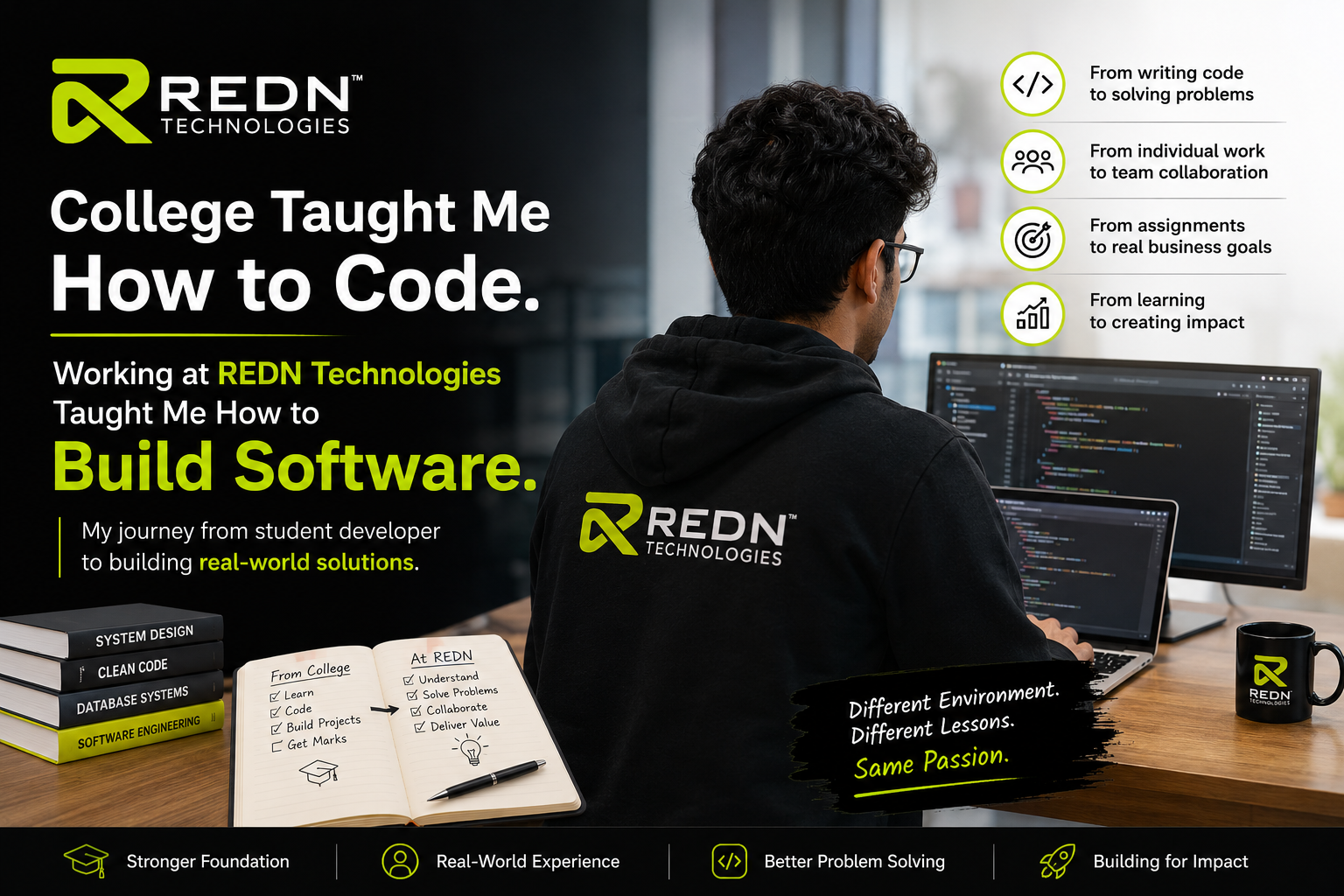
When I was pursuing my Computer Science degree, I believed that software development was primarily about writing code. The goal was simple: complete assignments, build projects, and ensure everything worked before submission.
Like many aspiring developers, I spent countless hours learning programming languages, experimenting with frameworks, and building academic projects. These experiences laid a strong technical foundation, but they represented only one side of software engineering.
Joining REDN Technologies as an Associate Software Engineer introduced me to the realities of building software for businesses and end users. It transformed my understanding of what software development truly means.
The Difference Between Academic Projects and Real-World Software
Most college projects have clearly defined requirements, fixed deadlines, and limited scope. Success is often measured by whether the application works as expected.
In the professional world, success is measured differently.
Software must be:
Reliable and scalable
Easy to maintain
Secure and performant
Valuable to end users
Aligned with business goals
A feature that works technically may still fail if it does not solve the user's problem effectively.
This was one of the first lessons I learned while working on real-world projects.
Software Is Built for People, Not Just Systems
As developers, it's easy to focus on technologies, frameworks, and code quality.
However, end users rarely think about the technology behind an application.
They care about:
Ease of use
Performance
Reliability
Speed
Results
Understanding user needs became just as important as understanding technical requirements.
The focus shifted from "How can we build this?" to "How can we solve this problem effectively?"
Collaboration Is a Core Engineering Skill
In college, many projects are completed individually or in small teams.
Professional software development is highly collaborative.
Building successful software requires coordination between:
Developers
Designers
Project managers
QA teams
Clients
Clear communication, knowledge sharing, and teamwork play a critical role in delivering successful projects.
Technical skills remain important, but collaboration often determines project success.
The Importance of Understanding Business Requirements
One of the most valuable lessons I learned at REDN Technologies is that software development starts long before coding begins.
Before implementing any feature, developers must understand:
The business objective
User expectations
Existing workflows
Potential challenges
Taking time to understand requirements often prevents costly mistakes later in the development cycle.
A well-understood problem usually leads to a better solution.
Why Problem-Solving Matters More Than Coding
Coding is a tool.
Problem-solving is the skill.
Modern software engineering requires developers to analyze challenges, evaluate alternatives, and create solutions that generate real value.
Whether it's improving user experience, automating a business process, or optimizing performance, the goal is always the same: solve problems efficiently.
This mindset has significantly changed the way I approach development.
Key Takeaways From My Journey
Looking back, college provided the technical fundamentals that helped me start my career.
Working at REDN Technologies has helped me understand how those fundamentals are applied in real-world environments.
Some of the most important lessons I've learned are:
Software is built to solve business problems.
User experience is as important as functionality.
Collaboration is essential for successful projects.
Understanding requirements saves development time.
Continuous learning is part of every software engineer's journey.
Final Thoughts
The transition from student developer to software engineer is about more than learning new technologies.
It's about developing a new perspective.
College taught me how to write code.
Working on real-world projects at REDN Technologies taught me how to build software that creates value for businesses and users.
And for me, that has made all the difference.